
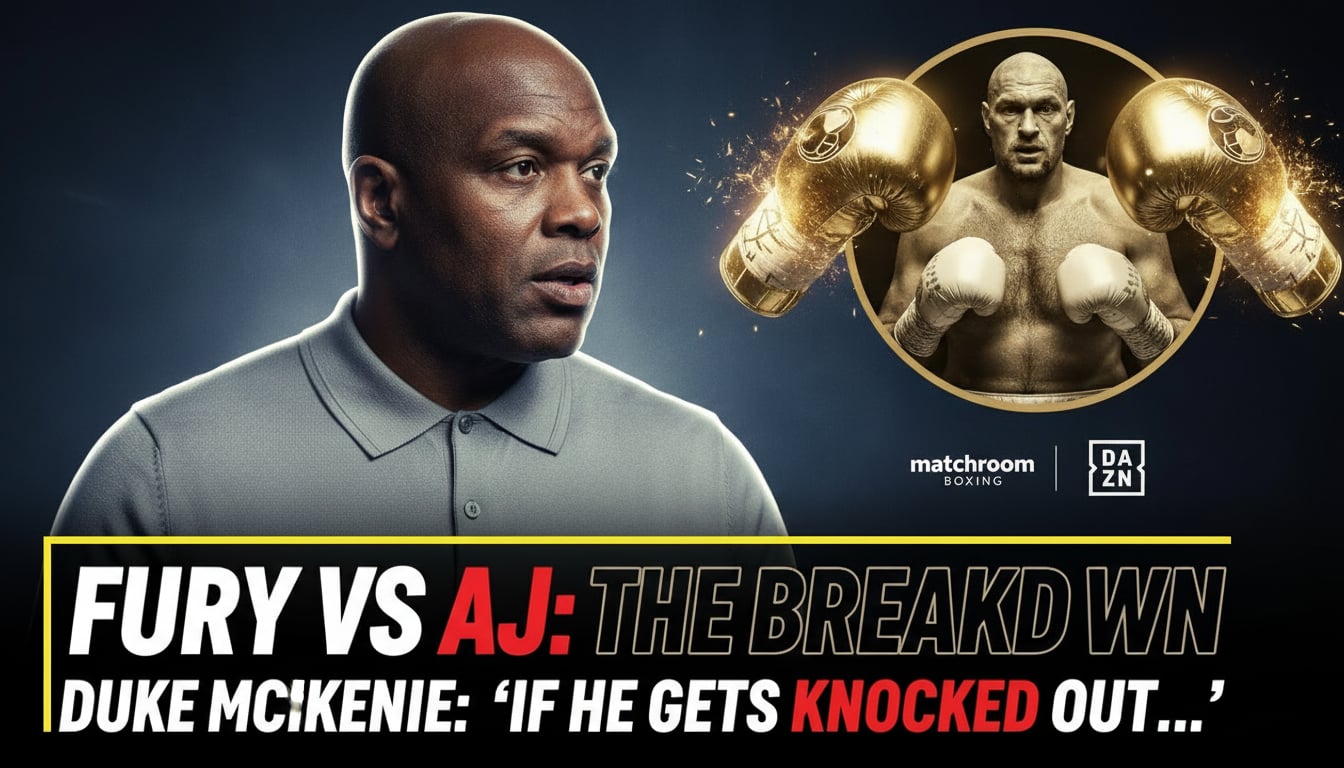
McKenzie: AJ Knocks Fury Out
The Fight That Still Captures the Imagination
In the ever-shifting landscape of heavyweight boxing, one matchup remains the magnetic north for fans, pundits, and fighters alike: Tyson Fury versus Anthony Joshua. Other bouts, like the impressive trades between Daniel Dubois and Zhilei Zhang, offer excitement, but as former three-weight world champion Duke McKenzie notes, nothing captures the public's imagination quite like the prospect of an all-British super-fight between the two biggest names in the division. It's the domestic clash that went global, a career-defining showdown that, despite years of delays and boxing politics, has lost none of its shine. And according to McKenzie, if and when it finally happens, there’s a clear winner.
Power: The Last Thing a Fighter Loses
McKenzie’s prediction hinges on a fundamental truth of the fight game. “The last thing you lose as a fighter is your punch,” he states, and in Anthony Joshua, we have one of the most concussive punchers of the modern era. While critics have pointed to a period of hesitation in AJ’s career following his losses to Oleksandr Usyk, his recent form tells a different story. Destructive knockouts over Francis Ngannou and Otto Wallin, regardless of the opposition's pedigree, have reignited the aggressive instinct that made him a unified champion. McKenzie believes Joshua has “just enough in the tank” to get the job done, rediscovering the desire to throw the punishing shots that can end any fight in an instant. That devastating power, McKenzie argues, is the ultimate equalizer and AJ’s primary key to victory.
A Fading Fury?
On the other side of the ring stands Tyson Fury, the enigmatic and undefeated ‘Gypsy King.’ Yet, McKenzie voices a concern that has been quietly growing in boxing circles. “I don't see that Fury can do what he used to be able to do against Joshua,” he posits. The sentiment points towards a potential decline in the lineal champion. Fury’s razor-thin, controversial victory over a boxing novice in Francis Ngannou did little to quell these fears. His once-unsolvable puzzle of feints, slick movement, and awkward rhythm appeared vulnerable. While Fury’s ring IQ is second to none, McKenzie’s analysis suggests that the physical attributes that made him so dominant might be waning, opening the door for a powerhouse like Joshua to capitalize in a way no one has before.
A Different Beast to Deontay Wilder
Perhaps the most compelling part of McKenzie’s argument is his physical comparison of Joshua to Fury’s greatest rival, Deontay Wilder. Fury’s trilogy with Wilder, which McKenzie calls his “best victory,” was defined by his ability to use his significant size advantage to lean on, bully, and wear down the notoriously powerful but physically slighter American. “Deontay Wilder was quite slight,” McKenzie recalls. “He’s not be able to do that with AJ.” This is the crucial difference. Joshua is, in McKenzie’s words, a “big man mountain.” He possesses a physique that can match Fury’s mass and a strength that would prevent the mauling tactics that proved so effective against Wilder. Against AJ, Fury would be facing an opponent he can’t simply out-muscle, forcing a more technical and dangerous fight at range where Joshua’s power becomes an even greater threat.
The Big Right Hand Finishes It
Ultimately, for Duke McKenzie, the fight boils down to a dramatic and definitive conclusion. The combination of Joshua’s rediscovered aggression, his unshakeable power, and his sheer physical presence creates a perfect storm that he believes the current version of Tyson Fury cannot weather. The tactical advantages Fury held over smaller men disappear against an athlete of AJ’s stature and strength. When all is said and done, McKenzie sees the fight ending in spectacular fashion. “I see AJ's big right hand probably putting his lights out,” he concludes. It’s a bold prediction, but one rooted in a sharp analysis of where both giants of the heavyweight division stand today.