
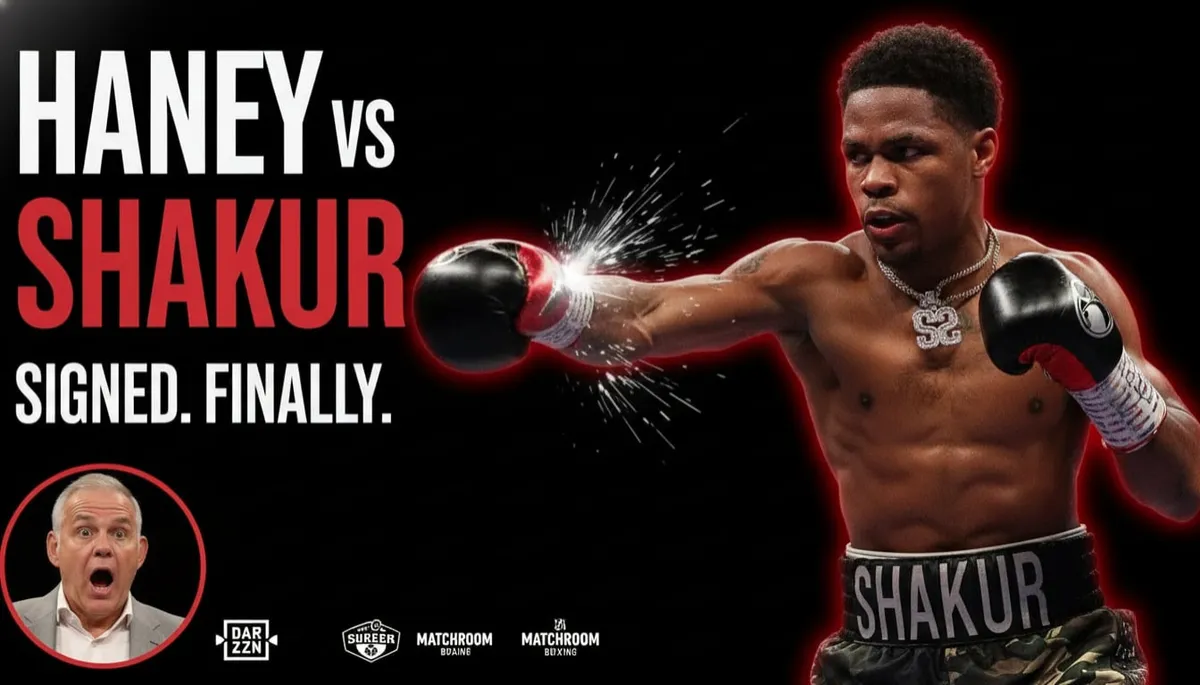
The Rule That Blocks a
A Chess Match in Limbo
For years, the names Devin Haney and Shakur Stevenson have been linked, not just as contemporaries, but as two sides of the same exquisitely crafted coin. In one corner, you have Haney, the former undisputed lightweight king who moved up to campaign at 140 pounds, a fighter defined by his piston-like jab and masterful control of distance. In the other, Stevenson, the preternaturally gifted defensive wizard whose reflexes and counter-punching ability have drawn comparisons to Pernell Whitaker and a young Floyd Mayweather. A fight between them isn't just a fight; it's a strategic masterpiece waiting to be painted on the canvas, a battle for technical supremacy that has the purists of the sport salivating.
They are the two fighters no one is in a hurry to face. Their styles are puzzles designed to frustrate and neutralize opponents, making a matchup between them the ultimate test of boxing IQ. Yet, as of late 2026, this grandmaster-level chess match remains a fantasy, a topic of heated debate on social media and in barbershops, but nowhere close to being signed. A recent video title from 'ShowBizz The Adult' puts a fine point on the frustration, suggesting a single 'rule' is all that stands in the way of the fight we all want to see.
When Business Kills a Bout
The path to a Haney-Stevenson showdown is littered with the usual roadblocks that plague modern boxing: promotional alignments, network loyalties, and, most venomously, money. The public negotiations, or lack thereof, have been a case study in frustration. Offers have been made and publicly rejected, often with derision. The concept of the 'A-side' and 'B-side' has created a chasm between the two camps, with disagreements over purse splits consistently cited as the primary deal-breaker. Both men believe they are the main draw, the fighter who brings more value to the promotion, and neither has been willing to concede an inch on their perceived worth.
This isn't a new story in boxing, but it feels particularly egregious here. We have two American stars, both in their prime, whose skills are perfectly matched to create a memorable, tactical war. Yet, the business of the sport—the very framework that is supposed to facilitate these events—has become the primary obstacle. Fans are left to watch them take on other opponents, all while knowing that the most compelling challenge for each man is the other.
The Hypothetical Rule to Save Boxing
This brings us to the video's intriguing premise: what if one rule change could make this fight happen? While the video itself doesn't specify, one can speculate. Perhaps it’s a mandated purse split for fights between champions or top-five contenders, removing the endless back-and-forth. For example, a non-negotiable 60/40 or 55/45 split in favor of the reigning champion could eliminate the lowball offers that poison negotiations from the start. Or maybe it’s a rule that gives an independent body the power to send a mega-fight to a purse bid if negotiations stall for too long, forcing the hands of reluctant promoters.
Whatever the specific 'rule' might be, the sentiment behind it is clear: the sport needs a mechanism to save itself from its own worst tendencies. The freedom of negotiation is one thing, but when it consistently prevents the best from fighting the best, it harms the entire ecosystem. It devalues championships, disappoints the paying public, and robs fighters of their legacy-defining moments.
A Legacy Defining Fight on Hold
And make no mistake, legacies are on the line. For Devin Haney, a victory over Stevenson would be the ultimate validation of his skills, proving he can out-think and out-box the most elusive fighter of his era. For Shakur Stevenson, a win over Haney would silence any critics of his safety-first style and anoint him as the undisputed king of boxing's new generation of technicians. It’s a fight that would define the mid-to-late 2020s. The winner would not just hold a belt; they would hold the crown of boxing’s supreme thinker.
For now, however, we are left to wait. We wait for egos to subside, for promoters to find common ground, and for the fighters themselves to decide that legacy is worth more than a few extra percentage points. Until then, Haney vs. Stevenson will remain the fight that 'would've been signed,' a ghost that haunts the lightweight and super lightweight divisions.